Musical Ordinary and Canon (Anglican Missal)
Work in progress: Musical Ordinary and Canon, words only (notation in the thumbnails), scan PDF pp. 559–662
Ordinary of the Mass
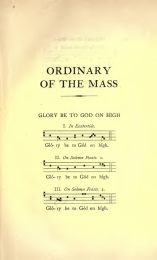
Glory be to God on high — the intonations
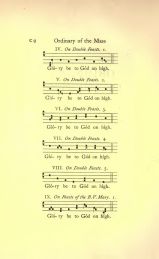
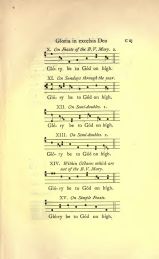
Each setting below prints one chant staff with the underlaid words "Glory be to God on high." The notation is in the scan images only; the words are the same in all fifteen settings. No further text of the Gloria is printed in this block.
Glory be to God on high.
- I. In Eastertide. (PDF 559) - II. On Solemn Feasts. 1. (PDF 559) - III. On Solemn Feasts. 2. (PDF 559) - IV. On Double Feasts. 1. (PDF 560, C ij) - V. On Double Feasts. 2. (PDF 560, C ij) - VI. On Double Feasts. 3. (PDF 560, C ij) - VII. On Double Feasts. 4. (PDF 560, C ij) - VIII. On Double Feasts. 5. (PDF 560, C ij) - IX. On Feasts of the B.V. Mary. 1. (PDF 560, C ij) - X. On Feasts of the B.V. Mary. 2. (PDF 561, C iij; running head "Gloria in excelsis Deo") - XI. On Sundays through the year. (PDF 561, C iij) - XII. On Semi-doubles. 1. (PDF 561, C iij) - XIII. On Semi-doubles. 2. (PDF 561, C iij) - XIV. Within Octaves which are not of the B.V. Mary. (PDF 561, C iij) - XV. On Simple Feasts. (PDF 561, C iij)
The Creed — the intonations
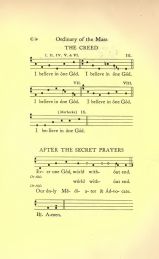
Each setting below prints one chant staff with the underlaid words "I believe in one God." The notation is in the scan images only; the words are the same in all settings. No further text of the Creed is printed in this block. (PDF 562, C iv)
I believe in one God.
- I. II. IV. V. & VI. (one staff) - III. (one staff) - VII. (one staff) - VIII. (one staff) - (Merbecke) IX. (one staff)
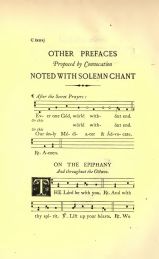
After the Secret Prayers
Printed at PDF 562 (C iv), under chant, and repeated identically at PDF 634 (C lxxvj) at the head of the Other Prefaces. The notation is in the scan images only.
Ever one God, world without end.
Or this
world without end.
Or this
Our only Mediator and Advocate.
℟. Amen.
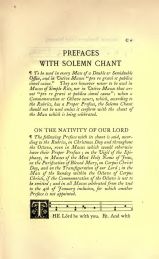
Prefaces with Solemn Chant
Introductory rubric, PDF 563 (C v):
¶ To be used in every Mass of a Double or Semidouble Office, and in Votive Masses "pro re gravi et publica simul causa." They are however never to be used in Masses of Simple Rite, nor in Votive Masses that are not "pro re gravi et publica simul causa": when a Commemoration or Octave occurs, which, according to the Rubrics, has a Proper Preface, the Solemn Chant should not be used unless it conform with the chant of the Mass which is being celebrated.
The shared text of every Preface in this block (dialogue, frame, lead-in), printed in full at the head of each Preface and identical in each except where a variation is noted at that Preface:
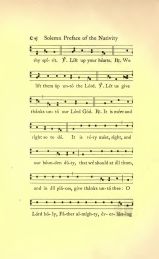
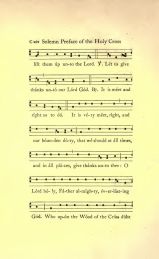
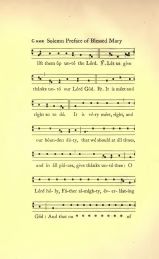
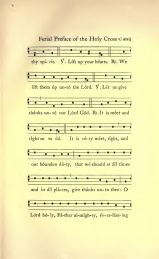
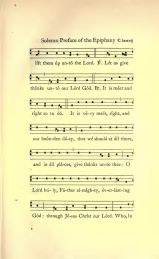
℣. The Lord be with you. ℟. And with thy spirit. ℣. Lift up your hearts. ℟. We lift them up unto the Lord. ℣. Let us give thanks unto our Lord God. ℟. It is meet and right so to do.
It is very meet, right, and our bounden duty, that we should at all times, and in all places give thanks unto thee: O Lord holy, Father almighty, everlasting God.
[Proper middle of the Preface — see each Preface below.]
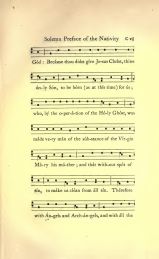
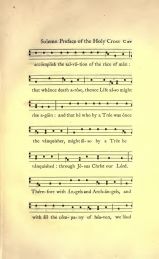
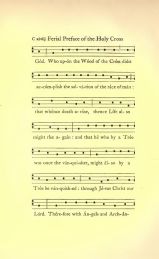
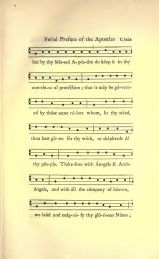
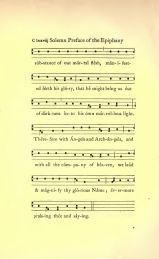
Therefore with Angels and Archangels, and with all the company of heaven, we laud and magnify thy glorious Name; evermore praising thee, and saying.
The dialogue above is printed on PDF 563–564 (Nativity), 566 (Epiphany), 569 (Lent), 571–572 (Holy Cross), 574–575 (Easter), 577–578 (Ascension), 580–581 (Holy Ghost), 584–585 (Holy Trinity), 587–588 (Blessed Mary), 590–591 (St. Joseph), 593–594 (Apostles), 596–597 (Feasts); the frame and lead-in on the pages following in each Preface, as cited below.
On the Nativity of our Lord
PDF 563–566 (C v–C viij).
¶ The following Preface with its chant is said, according to the Rubrics, on Christmas Day and throughout the Octave, even in Masses which would otherwise have their Proper Preface; on the Vigil of the Epiphany, in Masses of the Most Holy Name of Jesus, on the Purification of Blessed Mary, on Corpus Christi Day, and on the Transfiguration of our Lord; in the Mass of the Sunday within the Octave of Corpus Christi, if the Commemoration of the Octave is not to be omitted; and in all Masses celebrated from the 2nd to the 4th of January inclusive, for which another Preface is not appointed.
[Dialogue and frame as above.]
Because thou didst give Jesus Christ, thine only Son, to be born (as at this time) for us; who, by the operation of the Holy Ghost, was made very man of the substance of the Virgin Mary his mother; and that without spot of sin, to make us clean from all sin.
[Lead-in as above.]
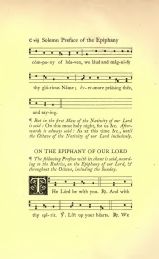
¶ But in the first Mass of the Nativity of our Lord is said: On this most holy night, for us &c. Afterwards is always said: As at this time &c., until the Octave of the Nativity of our Lord inclusively. (PDF 566, C viij)
A footnote marker "1*" stands at the foot of C vij (PDF 565); no footnote text appears on that leaf or the following leaves.
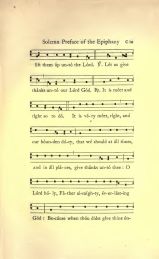
On the Epiphany of our Lord
PDF 566–568 (C viij–C x).
¶ The following Preface with its chant is said, according to the Rubrics, on the Epiphany of our Lord, and throughout the Octave, including the Sunday.
[Dialogue and frame as above.]
Because when thou didst give thine only Son in likeness of our mortal flesh, he restored us by the new star of his own deathless life.
[Lead-in as above.]
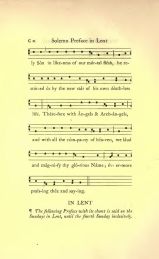
In Lent
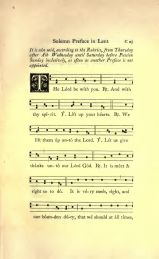
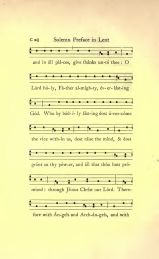
PDF 568–571 (C x–C xiij).
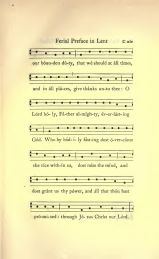
¶ The following Preface with its chant is said on the Sundays in Lent, until the fourth Sunday inclusively.
It is also said, according to the Rubrics, from Thursday after Ash Wednesday until Saturday before Passion Sunday inclusively, as often as another Preface is not appointed. (PDF 569, C xj)
[Dialogue and frame as above.]
Who by bodily fasting dost overcome the vice within us, dost raise the mind, and dost grant us thy power, and all that thou hast promised: through Jesus Christ our Lord.
[Lead-in as above.]
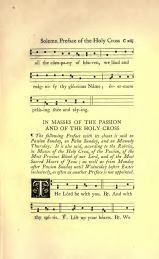
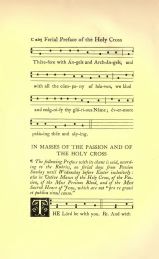
In Masses of the Passion and of the Holy Cross
PDF 571–574 (C xiij–C xvj; the Holy Cross Preface ends at the top of PDF 574, C xvj).
¶ The following Preface with its chant is said on Passion Sunday, on Palm Sunday, and on Maundy Thursday. It is also said, according to the Rubrics, in Masses of the Holy Cross, of the Passion, of the Most Precious Blood of our Lord, and of the Most Sacred Heart of Jesus; as well as from Monday after Passion Sunday until Wednesday before Easter inclusively, as often as another Preface is not appointed.
[Dialogue and frame as above.]
Who upon the Wood of the Cross didst accomplish the salvation of the race of man: that whence death arose, thence Life also might rise again: and that he who by a tree was once the vanquisher, might also by a Tree be vanquished: through Jesus Christ our Lord.
[Lead-in as above.]
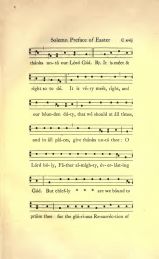
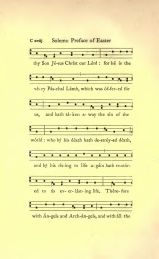
In Easter
PDF 574–577 (C xvj–C xix).
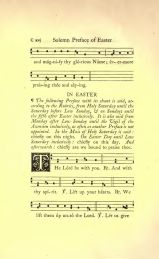
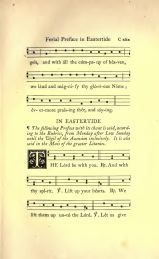
¶ The following Preface with its chant is said, according to the Rubrics, from Holy Saturday until the Saturday before Low Sunday, and on Sundays until the fifth after Easter inclusively. It is also said from Monday after Low Sunday until the Vigil of the Ascension inclusively, as often as another Preface is not appointed. In the Mass of Holy Saturday is said: chiefly on this night. On Easter Day until Low Saturday inclusively: chiefly on this day. And afterwards: chiefly are we bound to praise thee.
[Dialogue and frame as above.]
But chiefly * * * are we bound to praise thee for the glorious Resurrection of thy Son Jesus Christ our Lord: for he is the very Paschal Lamb, which was offered for us, and hath taken away the sin of the world: who by his death hath destroyed death, and by his rising to life again hath restored to us everlasting life.
The three stars stand in the chant in place of the variable words ("on this night", "on this day"), as directed by the rubric above. [Lead-in as above.]
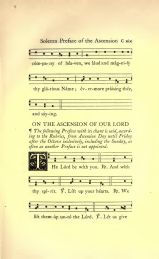
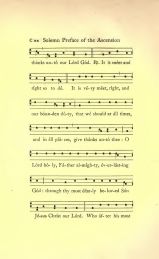
On the Ascension of our Lord
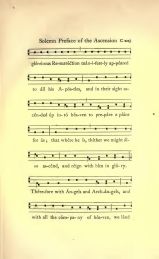
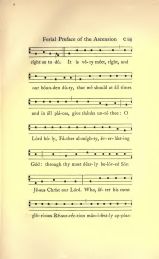
PDF 577–580 (C xix–C xxij).
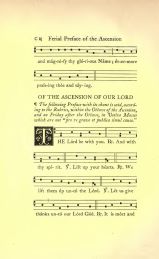
¶ The following Preface with its chant is said, according to the Rubrics, from Ascension Day until Friday after the Octave inclusively, including the Sunday, as often as another Preface is not appointed.
[Dialogue and frame as above.]
through thy most dearly beloved Son Jesus Christ our Lord. Who, after his most glorious Resurrection manifestly appeared to all his Apostles, and in their sight ascended up into heaven to prepare a place for us; that where he is, thither we might also ascend, and reign with him in glory.
[Lead-in as above.]
At Pentecost and in Votive Masses of the Holy Ghost
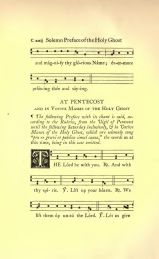
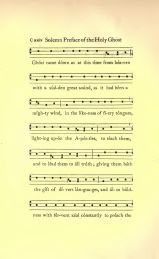
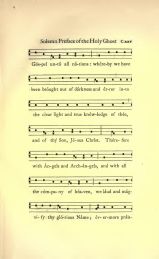
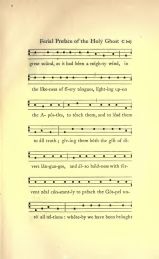
PDF 580–584 (C xxij–C xxvj).
¶ The following Preface with its chant is said, according to the Rubrics, from the Vigil of Pentecost until the following Saturday inclusively, and in Votive Masses of the Holy Ghost, which are solemnly sung "pro re gravi et publica simul causa," the words as at this time, being in this case omitted.
[Dialogue and frame as above.]
through Jesus Christ our Lord; according to whose most true promise, the Holy Ghost came down as at this time from heaven with a sudden great sound, as it had been a mighty wind, in the likeness of fiery tongues, lighting upon the Apostles, to teach them, and to lead them to all truth; giving them both the gift of divers languages, and also boldness with fervent zeal constantly to preach the Gospel unto all nations: whereby we have been brought out of darkness and error into the clear light and true knowledge of thee, and of thy Son, Jesus Christ.
[Lead-in as above.]
On the Feast of the Most Holy Trinity and on Sundays throughout the year
PDF 584–587 (C xxvj–C xxix).
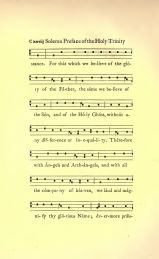
¶ The following Preface with its chant is said, according to the Rubrics, in Masses of the Most Holy Trinity, and on all Sundays throughout the year, even though anticipated, which have no proper Preface nor Preface of the Season assigned to them; including the first Sunday after Trinity, if the Commemoration of the Octave of Corpus Christi be omitted at the Mass. On Trinity Sunday the words holy, Father are omitted.
[Dialogue as above; frame with the bracketed words as printed:]
It is very meet, right, and our bounden duty, that we should at all times, and in all places give thanks unto thee: O Lord [holy, Father] almighty, everlasting God: Who art one God, one Lord; not one only Person, but three Persons in one Substance. For that which we believe of the glory of the Father, the same we believe of the Son, and of the Holy Ghost, without any difference or inequality.
[Lead-in as above.]
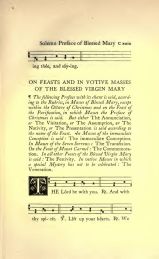
On Feasts and in Votive Masses of the Blessed Virgin Mary
PDF 587–590 (C xxix–C xxxij; the Blessed Mary Preface ends at the top of PDF 590, C xxxij).
¶ The following Preface with its chant is said, according to the Rubrics, in Masses of Blessed Mary, except within the Octave of Christmas and on the Feast of the Purification, in which Masses the Preface of Christmas is said. But either The Annunciation, or The Visitation, or The Assumption, or The Nativity, or The Presentation is said according to the name of the Feast. In Masses of the Immaculate Conception is said: The Immaculate Conception. In Masses of the Seven Sorrows: The Transfixion. On the Feast of Mount Carmel: The Commemoration. In all other Feasts of the Blessed Virgin Mary is said: The Festivity. In votive Masses in which a special Mystery has not to be celebrated: The Veneration.
[Dialogue and frame as above.]
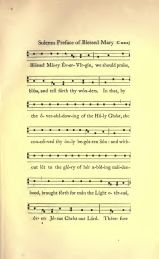
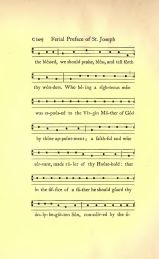
And that on * * * * * * * * of Blessed Mary Ever-Virgin, we should praise, bless, and tell forth thy wonders. In that, by the overshadowing of the Holy Ghost, she conceived thy only-begotten Son: and without let to the glory of her abiding maidenhood, brought forth for man the Light eternal, even Jesus Christ our Lord.
The eight stars stand in the chant in place of the feast-name words, as directed by the rubric above. [Lead-in as above.]
A footnote marker "2" stands at the foot of C xxxj (PDF 589); no footnote text appears on that leaf or the following leaves.
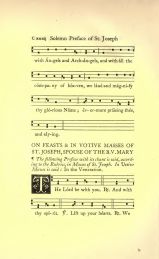
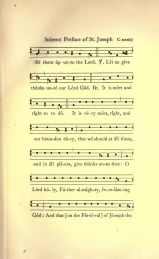
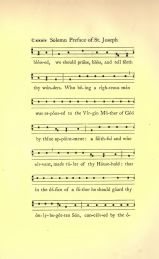
On Feasts and in Votive Masses of St. Joseph, Spouse of the B.V. Mary
PDF 590–593 (C xxxij–C xxxv).
¶ The following Preface with its chant is said, according to the Rubrics, in Masses of St. Joseph. In Votive Masses is said: In the Veneration.
[Dialogue and frame as above.]
And that [on the Festival] of Joseph the blessed, we should praise, bless, and tell forth thy wonders. Who being a righteous man was espoused to the Virgin Mother of God by thine appointment: a faithful and wise servant, made ruler of thy Household: that in the office of a father he should guard thy only-begotten Son, conceived by the overshadowing of the Holy Ghost, even Jesus Christ our Lord.
[Lead-in as above.]
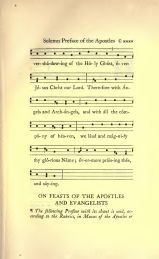
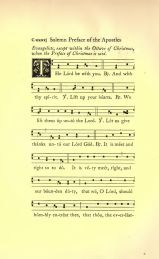
On Feasts of the Apostles and Evangelists
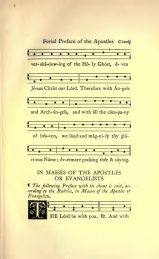
PDF 593–596 (C xxxv–C xxxviij).
¶ The following Preface with its chant is said, according to the Rubrics, in Masses of the Apostles or Evangelists, except within the Octave of Christmas, when the Preface of Christmas is said.
[Dialogue as above; the frame is replaced by the following proper text, which runs straight to the lead-in:]
It is very meet, right, and our bounden duty, that we, O Lord, should humbly entreat thee, that thou, the everlasting Shepherd, do not leave thy flock untended: but by thy blessed Apostles do keep it in thy continual protection: That it may be governed by those same rulers, whom, in thy stead, thou hast given for thy work, as shepherds of thy people.
[Lead-in as above.]
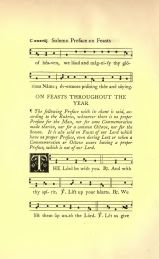
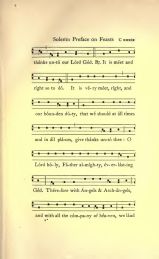
On Feasts throughout the year
PDF 596–598 (C xxxviij–C xl).
¶ The following Preface with its chant is said, according to the Rubrics, whenever there is no proper Preface for the Mass, nor for some Commemoration made therein, nor for a common Octave, nor for the Season. It is also said on Feasts of our Lord which have no proper Preface, even during Lent or when a Commemoration or Octave occurs having a proper Preface, which is not of our Lord.
[Dialogue and common frame as above, with no proper middle; the frame runs straight to the lead-in.]
A footnote marker "2*" stands at the foot of C xxxix (PDF 597); no footnote text appears on that leaf or the following leaves.
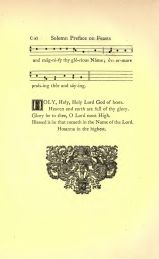
Sanctus — as printed at the end of the Solemn Prefaces
PDF 598 (C xl), in ordinary type (not under chant), with decorated initial, followed by a tailpiece:
HOLY, Holy, Holy Lord God of hosts. Heaven and earth are full of thy glory. Glory be to thee, O Lord most High. Blessed is he that cometh in the Name of the Lord. Hosanna in the highest.
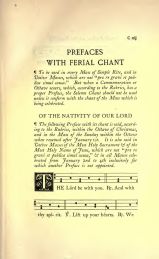
Prefaces with Ferial Chant
Introductory rubric, PDF 599 (C xlj):
¶ To be used in every Mass of Simple Rite, and in Votive Masses, which are not "pro re gravi et publica simul causa." But when a Commemoration or Octave occurs, which, according to the Rubrics, has a proper Preface, the Solemn Chant should not be used unless it conform with the chant of the Mass which is being celebrated.
The dialogue, frame, and lead-in are as given in full before the Solemn Prefaces, printed identically in each ferial Preface. The Sanctus, printed in ordinary type at the end of this set (PDF 633, C lxxv), is the same text as at C xl above. Each ferial Preface below gives its own rubric in full and its middle, cross-referred to the solemn middle where the words are the same.
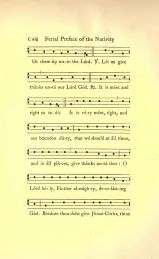
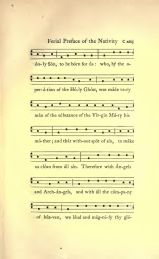
Of the Nativity of our Lord (ferial)
PDF 599–602 (C xlj–C xliv; the ferial Nativity Preface ends at the top of PDF 602, C xliv).
¶ The following Preface with its chant is said, according to the Rubrics, within the Octave of Christmas, and in the Mass of the Sunday within the Octave when resumed after January 1st. It is also said in Votive Masses of the Most Holy Sacrament and of the Most Holy Name of Jesus, which are not "pro re gravi et publica simul causa," and in all Masses celebrated from January 2nd to 4th inclusively for which another Preface is not appointed.
[Dialogue and frame as above.]
Because thou didst give Jesus Christ, thine only Son, to be born for us; who, by the operation of the Holy Ghost, was made very man of the substance of the Virgin Mary his mother; and that without spot of sin, to make us clean from all sin.
As the solemn Nativity middle, except that the parenthetical "(as at this time)" is omitted. [Lead-in as above.]
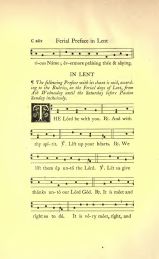
In Lent (ferial)
PDF 602–604 (C xliv–C xlvj).
¶ The following Preface with its chant is said, according to the Rubrics, on the Ferial days of Lent, from Ash Wednesday until the Saturday before Passion Sunday inclusively.
[Dialogue and frame as above.]
Who by bodily fasting dost overcome the vice within us, dost raise the mind, and dost grant us thy power, and all that thou hast promised: through Jesus Christ our Lord.
As the solemn Lent middle, with "and" spelled out where the solemn chant prints "&". [Lead-in as above.]
In Masses of the Passion and of the Holy Cross (ferial)
PDF 604–607 (C xlvj–C xlix).
¶ The following Preface with its chant is said, according to the Rubrics, on ferial days from Passion Sunday until Wednesday before Easter inclusively: also in Votive Masses of the Holy Cross, of the Passion, of the Most Precious Blood, and of the Most Sacred Heart of Jesus, which are not "pro re gravi et publica simul causa."
[Dialogue and frame as above.]
Who upon the Wood of the Cross didst accomplish the salvation of the race of man: that whence death arose, thence Life also might rise again: and that he who by a tree was once the vanquisher, might also by a Tree be vanquished: through Jesus Christ our Lord.
As the solemn Holy Cross middle. [Lead-in as above.]
In Eastertide (ferial)
PDF 607–610 (C xlix–C lij).
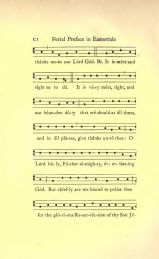
¶ The following Preface with its chant is said, according to the Rubrics, from Monday after Low Sunday until the Vigil of the Ascension inclusively. It is also said in the Mass of the greater Litanies.
[Dialogue and frame as above.]
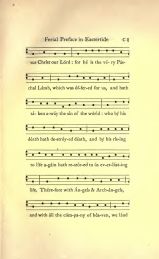
But chiefly are we bound to praise thee for the glorious Resurrection of thy Son Jesus Christ our Lord: for he is the very Paschal Lamb, which was offered for us, and hath taken away the sin of the world: who by his death hath destroyed death, and by his rising to life again hath restored to us everlasting life.
As the solemn Easter middle in its "afterwards" form, with no stars. [Lead-in as above.]
Of the Ascension of our Lord (ferial)
PDF 610–613 (C lij–C lv).
¶ The following Preface with its chant is said, according to the Rubrics, within the Octave of the Ascension, and on Friday after the Octave, in Votive Masses which are not "pro re gravi et publica simul causa."
[Dialogue and frame as above.]
through thy most dearly beloved Son Jesus Christ our Lord. Who, after his most glorious Resurrection manifestly appeared to all his Apostles, and in their sight ascended up into heaven to prepare a place for us; that where he is, thither we might also ascend, and reign with him in glory.
As the solemn Ascension middle. [Lead-in as above.]
In Votive Masses of the Holy Ghost (ferial)
PDF 613–616 (C lv–C lviij).
¶ The following Preface with its chant is said, according to the Rubrics, in Votive Masses of the Holy Ghost, which are not "pro re gravi et publica simul causa."
[Dialogue and frame as above.]
through Jesus Christ our Lord; according to whose most true promise, the Holy Ghost came down from heaven with a sudden great sound, as it had been a mighty wind, in the likeness of fiery tongues, lighting upon the Apostles, to teach them, and to lead them to all truth; giving them both the gift of divers languages, and also boldness with fervent zeal constantly to preach the Gospel unto all nations: whereby we have been brought out of darkness and error into the clear light and true knowledge of thee, and of thy Son, Jesus Christ.
As the solemn Pentecost middle, except that the words "as at this time" are omitted, as the solemn rubric directs for votive use. [Lead-in as above.]
In Votive Masses of the Most Holy Trinity (ferial)
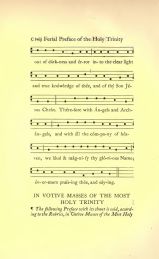
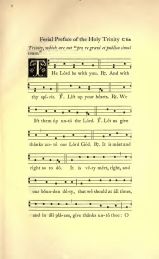
PDF 616–619 (C lviij–C lxj).
¶ The following Preface with its chant is said, according to the Rubrics, in Votive Masses of the Most Holy Trinity, which are not "pro re gravi et publica simul causa."
[Dialogue as above; frame without brackets:]
It is very meet, right, and our bounden duty, that we should at all times, and in all places give thanks unto thee: O Lord holy, Father almighty, everlasting God: Who art one God, one Lord; not one only Person, but three Persons in one Substance. For that which we believe of the glory of the Father, the same we believe of the Son, and of the Holy Ghost, without any difference or inequality.
As the solemn Trinity middle, without the brackets (no Trinity Sunday omission applies to this votive use). [Lead-in as above.]
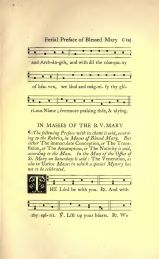
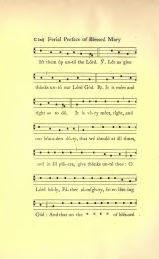
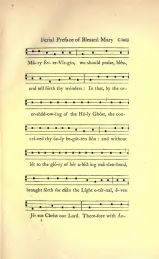
In Masses of the B.V. Mary (ferial)
PDF 619–622 (C lxj–C lxiv).
¶ The following Preface with its chant is said, according to the Rubrics, in Masses of Blessed Mary. But either The Immaculate Conception, or The Transfixion, or The Assumption, or The Nativity is said, according to the Mass. In the Mass of the Office of St. Mary on Saturdays is said: The Veneration, as also in Votive Masses in which a special Mystery has not to be celebrated.
[Dialogue and frame as above.]
And that on the * * * * of blessed Mary Ever-Virgin, we should praise, bless, and tell forth thy wonders. In that, by the overshadowing of the Holy Ghost, she conceived thy only-begotten Son: and without let to the glory of her abiding maidenhood, brought forth for man the Light eternal, even Jesus Christ our Lord.
As the solemn Blessed Mary middle, with four stars in place of the feast-name words (eight in the solemn chant). [Lead-in as above.]
A footnote marker "3" stands at the foot of C lxiij (PDF 621); no footnote text appears on that leaf or the following leaves.
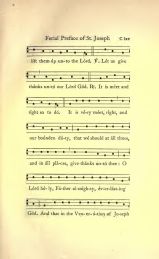
In Votive Masses of St. Joseph, Spouse of the B.V. Mary (ferial)
PDF 622–625 (C lxiv–C lxvii).
¶ The following Preface with its chant is said, according to the Rubrics, in Votive Masses of St. Joseph, which are not "pro re gravi et publica simul causa."
[Dialogue and frame as above.]
And that in the Veneration of Joseph the blessed, we should praise, bless, and tell forth thy wonders. Who being a righteous man was espoused to the Virgin Mother of God by thine appointment: a faithful and wise servant, made ruler of thy Household: that in the office of a father he should guard thy only-begotten Son, conceived by the overshadowing of the Holy Ghost, even Jesus Christ our Lord.
As the solemn St. Joseph middle, with "in the Veneration" in place of the bracketed "[on the Festival]". [Lead-in as above.]
In Masses of the Apostles or Evangelists (ferial)
PDF 625–628 (C lxvii–C lxx).
¶ The following Preface with its chant is said, according to the Rubrics, in Masses of the Apostles or Evangelists.
[Dialogue as above; proper text as the solemn Apostles entreaty:]
It is very meet, right, and our bounden duty, that we, O Lord, should humbly entreat thee, that thou, the everlasting Shepherd, do not leave thy flock untended: but by thy blessed Apostles do keep it in thy continual protection: That it may be governed by those same rulers, whom, in thy stead, thou hast given for thy work, as shepherds of thy people.
[Lead-in as above.]
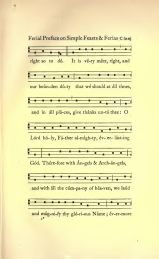
On Simple Feasts and Ferias (ferial)
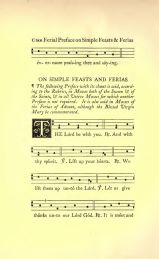
PDF 628–630 (C lxx–C lxxij).
¶ The following Preface with its chant is said, according to the Rubrics, in Masses both of the Season and of the Saints, and in all Votive Masses for which another Preface is not required. It is also said in Masses of the Ferias of Advent, although the Blessed Virgin Mary be commemorated.
[Dialogue and common frame as above, with no proper middle; the frame runs straight to the lead-in.]
A footnote marker "3*" stands at the foot of C lxxj (PDF 629); no footnote text appears on that leaf or the following leaves.
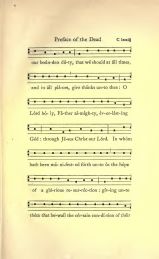
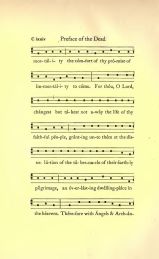
In Masses of the Dead
PDF 630–633 (C lxxij–C lxxv).
¶ The following Preface with its chant is said in all Masses of the Dead.
[Dialogue and frame as above.]
through Jesus Christ our Lord. In whom hath been manifested forth unto us the hope of a glorious resurrection: giving unto them that bewail the certain condition of their mortality the comfort of thy promise of immortality to come. For thou, O Lord, changest but takest not away the life of thy faithful people, granting unto them at the dissolution of the tabernacle of their earthly pilgrimage, an everlasting dwelling-place in the heavens.
[Lead-in as above.]
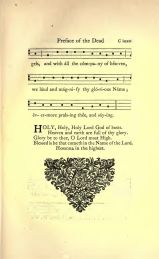
Sanctus — as printed at the end of the Ferial Prefaces
PDF 633 (C lxxv), in ordinary type, followed by a tailpiece; text as at C xl above:
HOLY, Holy, Holy Lord God of hosts. Heaven and earth are full of thy glory. Glory be to thee, O Lord most High. Blessed is he that cometh in the Name of the Lord. Hosanna in the highest.
Other Prefaces
PDF 634 (C lxxvj): "OTHER PREFACES / Proposed by Convocation / NOTED WITH SOLEMN CHANT". The "After the Secret Prayers" endings are repeated here in full, as at PDF 562 above. Each Preface below prints the dialogue, frame, and lead-in as in the Solemn Prefaces, with its own proper middle; no occasion rubric beyond the subheading is printed, except where stated. The Sanctus, printed in ordinary type at the end of this set (PDF 650, C xcij), is the same text as at C xl above.
On the Epiphany, and throughout the Octave
PDF 634–636 (C lxxvj–C lxxviij).
[Dialogue and frame as above.]
through Jesus Christ our Lord. Who, in substance of our mortal flesh, manifested forth his glory, that he might bring us out of darkness into his own marvellous light.
[Lead-in as above.]
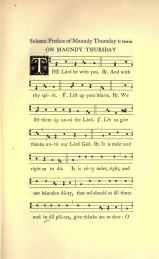
On Maundy Thursday
PDF 637–639 (C lxxix–C lxxxj).
[Dialogue and frame as above.]
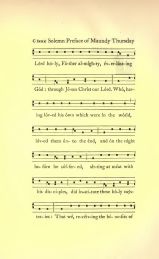
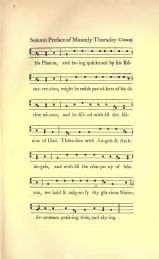
through Jesus Christ our Lord. Who, having loved his own which were in the world, loved them unto the end, and on the night before he suffered, sitting at meat with his disciples, did institute these holy mysteries: That we, receiving the benefits of his Passion, and being quickened by his Resurrection, might be made partakers of his divine nature, and be filled with all the fulness of God.
[Lead-in as above.]
A footnote marker "3**" stands at the foot of C lxxix (PDF 637); no footnote text appears on that leaf or the following leaves.
On the Feast of the Most Holy Trinity and on Sundays
PDF 640–642 (C lxxxij–C lxxxiv).
[Dialogue and frame as above.]
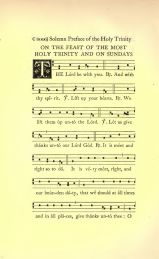
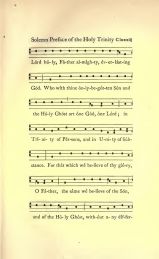
Who with thine only-begotten Son and the Holy Ghost art one God, one Lord; in Trinity of Persons, and in Unity of Substance. For that which we believe of thy glory, O Father, the same we believe of the Son, and of the Holy Ghost, without any difference or inequality.
This middle is distinct from both the solemn Trinity middle (C xxvj–C xxix) and the ferial Trinity middle (C lviij–C lxj). [Lead-in as above.]
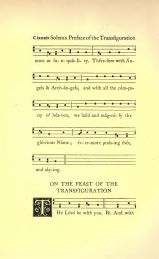
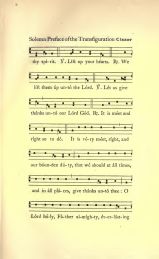
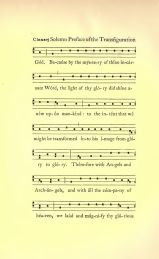
On the Feast of the Transfiguration
PDF 642–645 (C lxxxiv–C lxxxvij; the Transfiguration Preface ends at the top of PDF 645, C lxxxvij).
[Dialogue and frame as above.]
Because by the mystery of thine incarnate Word, the light of thy glory did shine anew upon mankind: to the intent that we might be transformed into his image from glory to glory.
[Lead-in as above.]
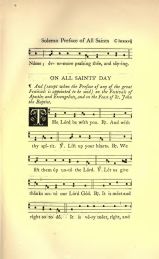
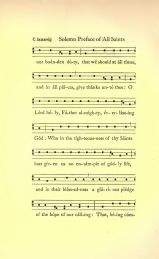
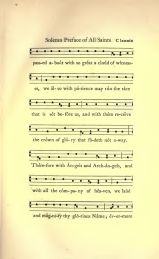
On All Saints' Day
PDF 645–648 (C lxxxvij–C xc; the All Saints Preface ends at the top of PDF 648, C xc).
¶ And (except when the Preface of any of the great Festivals is appointed to be said) on the Festivals of Apostles and Evangelists, and on the Feast of St. John the Baptist.
[Dialogue and frame as above.]
Who in the righteousness of thy Saints hast given us an ensample of godly life, and in their blessedness a glorious pledge of the hope of our calling: That, being compassed about with so great a cloud of witnesses, we also with patience may run the race that is set before us, and with them receive the crown of glory that fadeth not away.
[Lead-in as above.]
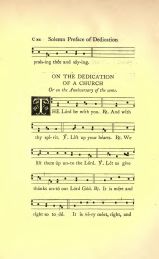
On the Dedication of a Church, or on the Anniversary of the same
PDF 648–650 (C xc–C xcij).
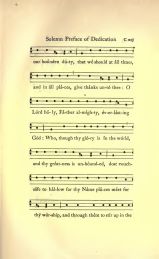
[Dialogue and frame as above.]
Who, though thy glory is in the world, and thy greatness is unbounded, dost vouchsafe to hallow for thy Name places meet for thy worship, and through them to stir up in the hearts of thy people the spirit of grace and of supplication.
[Lead-in as above.]
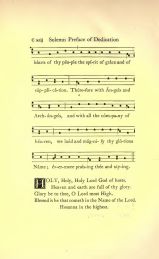
Sanctus — as printed at the end of the Other Prefaces
PDF 650 (C xcij), in ordinary type; text as at C xl above:
HOLY, Holy, Holy Lord God of hosts. Heaven and earth are full of thy glory. Glory be to thee, O Lord most High. Blessed is he that cometh in the Name of the Lord. Hosanna in the highest.
Canon of the Mass
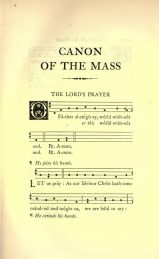
The Lord's Prayer
PDF 651 (title leaf, C xciij by sequence).
[The leaf begins in the middle of a chant; the parent prayer is not named on the leaf.]
O Father almighty, world without end.
or this
world without end.
℟. Amen.
¶ He joins his hands.
LET us pray: As our Saviour Christ hath commanded and taught us, we are bold to say:
¶ He extends his hands.
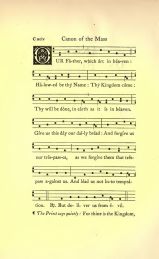
PDF 652 (C xciv), solemn tone:
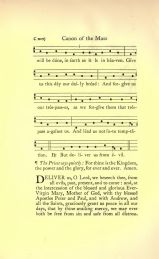
OUR Father, which art in heaven: Hallowed be thy Name: Thy Kingdom come: Thy will be done, in earth as it is in heaven. Give us this day our daily bread: And forgive us our trespasses, as we forgive them that trespass against us. And lead us not into temptation.
℟. But deliver us from evil.
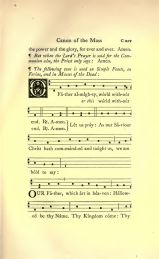
¶ The Priest says quietly: For thine is the Kingdom, (concluded on PDF 653, C xcv:)
the power and the glory, for ever and ever. Amen.
¶ But when the Lord's Prayer is said for the Communion also, the Priest only says: Amen.
¶ The following tone is used on Simple Feasts, on Ferias, and in Masses of the Dead:
[Same opening chant fragment as on the title leaf:]
Father almighty, world without end.
or this
world without end.
℟. Amen.
[Then:] Let us pray: As our Saviour Christ hath commanded and taught us, we are bold to say:
PDF 653–654 (C xcv–C xcvj), ferial tone, the Lord's Prayer in the same words as the solemn tone above:
OUR Father, which art in heaven: Hallowed be thy Name. Thy Kingdom come: Thy will be done, in earth as it is in heaven. Give us this day our daily bread: And forgive us our trespasses, as we forgive them that trespass against us. And lead us not into temptation.
℟. But deliver us from evil.
¶ The Priest says quietly: For thine is the Kingdom, the power and the glory, for ever and ever. Amen.
PDF 654 (C xcvj), in ordinary type (not under chant):
DELIVER us, O Lord, we beseech thee, from all evils, past, present, and to come: and, at the intercession of the blessed and glorious Ever-Virgin Mary, Mother of God, with thy blessed Apostles Peter and Paul, and with Andrew, and all the Saints, graciously grant us peace in all our days, that by thine availing mercy, we may ever both be free from sin and safe from all distress.
PDF 655 (C xcvij), in ordinary type, continuing:
Through the same Jesus Christ, thy Son, our Lord. Who liveth and reigneth with thee in the unity of the Holy Ghost,
[Under chant:]
Ever one God, world without end. ℟. Amen.
The peace ✠ of the Lord be ✠ alway with ✠ you.
℟. And with thy spirit.
The Dismissal
The notation is in the scan images only. The people's response ("Thanks be to God") is not printed in this block; only the priest's lines below are given.
PDF 655 (C xcvij):
I. In Eastertide.
From the Mass of Holy Saturday to the Saturday before Low Sunday inclusive, in Masses of the Season.
Depart in peace, Alleluia, Alleluia.
From Low Sunday to the Ember Saturday after Pentecost inclusive.
Depart in peace.
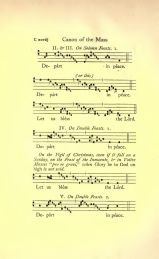
PDF 656 (C xcviij):
II. & III. On Solemn Feasts. 1.
Depart in peace.
(or this)
Depart in peace.
Let us bless the Lord.
IV. On Double Feasts. 1.
Depart in peace.
On the Vigil of Christmas, even if it fall on a Sunday, on the Feast of the Innocents, and in Votive Masses "pro re gravi," when Glory be to God on high is not said.
Let us bless the Lord.
V. On Double Feasts. 2.
Depart in peace.
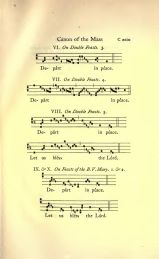
PDF 657 (C xcix):
VI. On Double Feasts. 3.
Depart in peace.
VII. On Double Feasts. 4.
Depart in peace.
VIII. On Double Feasts. 5.
Depart in peace.
Let us bless the Lord.
IX. & X. On Feasts of the B.V. Mary. 1. & 2.
Depart in peace.
Let us bless the Lord.
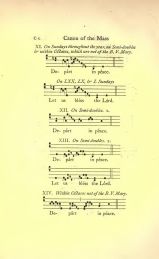
PDF 658 (C c):
XI. On Sundays throughout the year, on Semi-doubles and within Octaves, which are not of the B.V. Mary.
Depart in peace.
On LXX, LX, and L Sundays
Let us bless the Lord.
XII. On Semi-doubles. 1.
Depart in peace.
XIII. On Semi-doubles. 2.
Depart in peace.
Let us bless the Lord.
XIV. Within Octaves not of the B.V. Mary.
Depart in peace.
PDF 659 (C cj):
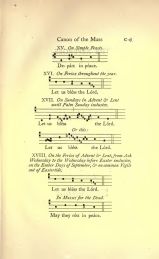
XV. On Simple Feasts.
Depart in peace.
XVI. On Ferias throughout the year.
Let us bless the Lord.
XVII. On Sundays in Advent and Lent until Palm Sunday inclusive.
Let us bless the Lord.
Or this:
Let us bless the Lord.
XVIII. On the Ferias of Advent and Lent, from Ash Wednesday to the Wednesday before Easter inclusive, on the Ember Days of September, and on common Vigils out of Eastertide.
Let us bless the Lord.
In Masses for the Dead.
May they rest in peace.
The Asperges
PDF 660 (C cij). Chant incipits only — the full text of the Asperges is not printed on this leaf. The notation is in the scan images only. The asterisks are as printed; their referent is not explained on this leaf.
I. Thou shalt purge me,*
II. Thou shalt purge me,*
III. Thou shalt purge me,*
IV. I beheld water,*
Followed by a tailpiece.
Plates closing the block
PDF 661: circular engraved device with the motto roundel "Go Ye Into All The World And Preach The Gospel To Every Creature." Foot mark "R". No other text. PDF 662: full-page engraving (the Risen Christ with the Apostles), no text. Easter Day follows at PDF 663, outside this range.
Source: The Anglican Missal (London: Society of SS. Peter and Paul, 1921), Musical Ordinary and Musical Canon, scan PDF pp. 559–662 (printed C j–C cij, with the Canon title leaf C xciij by sequence). Scan: Internet Archive digitization of the Trinity College, Toronto copy.
Source pages
Thumbnails of the source pages for the transcription above (Musical Ordinary and Canon, words only (notation in the thumbnails), scan PDF pp. 559–662). Click any thumbnail for the full page image.
-
 musical p559
-
 musical p560
-
 musical p561
-
 musical p562
-
 musical p563
-
 musical p564
-
 musical p565
-
 musical p566
-
 musical p567
-
 musical p568
-
 musical p569
-
 musical p570
-
 musical p571
-
 musical p572
-
 musical p573
-
 musical p574
-
 musical p575
-
 musical p576
-
 musical p577
-
 musical p578
-
 musical p579
-
 musical p580
-
 musical p581
-
 musical p582
-
 musical p583
-
 musical p584
-
 musical p585
-
 musical p586
-
 musical p587
-
 musical p588
-
 musical p589
-
 musical p590
-
 musical p591
-
 musical p592
-
 musical p593
-
 musical p594
-
 musical p595
-
 musical p596
-
 musical p597
-
 musical p598
-
 musical p599
-
 musical p600
-
 musical p601
-
 musical p602
-
 musical p603
-
 musical p604
-
 musical p605
-
 musical p606
-
 musical p607
-
 musical p608
-
 musical p609
-
 musical p610
-
 musical p611
-
 musical p612
-
 musical p613
-
 musical p614
-
 musical p615
-
 musical p616
-
 musical p617
-
 musical p618
-
 musical p619
-
 musical p620
-
 musical p621
-
 musical p622
-
 musical p623
-
 musical p624
-
 musical p625
-
 musical p626
-
 musical p627
-
 musical p628
-
 musical p629
-
 musical p630
-
 musical p631
-
 musical p632
-
 musical p633
-
 musical p634
-
 musical p635
-
 musical p636
-
 musical p637
-
 musical p638
-
 musical p639
-
 musical p640
-
 musical p641
-
 musical p642
-
 musical p643
-
 musical p644
-
 musical p645
-
 musical p646
-
 musical p647
-
 musical p648
-
 musical p649
-
 musical p650
-
 musical p651
-
 musical p652
-
 musical p653
-
 musical p654
-
 musical p655
-
 musical p656
-
 musical p657
-
 musical p658
-
 musical p659
-
 musical p660
-
 musical p661
-
 musical p662


