Psalm 5 (1928 BCP)
Psalm 5 (1928 BCP) is a morning prayer for God to hear, guide, and defend the worshipper amid deceit and violence. In the 1928 Book of Common Prayer, it concludes the first day's morning portion of the Psalter. Its movement from an individual's plea to joy for all who trust God makes it suited to the common voice of the Daily Office.
Text of the Psalm
The Prayer Book supplies the Latin opening Verba mea auribus. The asterisks divide the verses for reading or chanting:
PONDER my words, O LORD, * consider my meditation.
2 O hearken thou unto the voice of my calling, my King and my God: * for unto thee will I make my prayer.
3 My voice shalt thou hear betimes, O LORD; * early in the morning will I direct my prayer unto thee, and will look up.
4 For thou art the God that hast no pleasure in wickedness; * neither shall any evil dwell with thee.
5 Such as be foolish shall not stand in thy sight; * for thou hatest all them that work iniquity.
6 Thou shalt destroy them that speak lies: * the LORD will abhor both the blood-thirsty and deceitful man.
7 But as for me, in the multitude of thy mercy I will come into thine house; * and in thy fear will I worship toward thy holy temple.
8 Lead me, O LORD, in thy righteousness, because of mine enemies; * make thy way plain before my face.
9 For there is no faithfulness in their mouth; * their inward parts are very wickedness.
10 Their throat is an open sepulchre; * they flatter with their tongue.
11 Destroy thou them, O God; let them perish through their own imaginations; * cast them out in the multitude of their ungodliness; for they have rebelled against thee.
12 And let all them that put their trust in thee rejoice: * they shall ever be giving of thanks, because thou defendest them; they that love thy Name shall be joyful in thee;
13 For thou, LORD, wilt give thy blessing unto the righteous, * and with thy favourable kindness wilt thou defend him as with a shield.
Words, meditation, and morning prayer
The opening asks God to attend both to spoken words and to meditation. The speaker addresses God as “my King and my God,” and resolves to direct prayer to him early and to look up. The psalm does not describe prayer as a way of controlling the day's outcome: it begins in dependence on the one addressed.
Anglican priest John Mason Neale distinguishes the verbal and inward dimensions of the first verse:
Here we distinguish two kinds of prayer: words and meditations.
Neale includes both the Church's forms of prayer and the thoughts and desires of the heart in his exposition. The distinction illuminates the Office: a congregation can use shared words while bringing to them concerns that are not spoken aloud.
Holiness, mercy, and guidance
The psalm's sharp denial that wickedness can dwell with God is followed by an appeal to divine mercy, not by a claim that the speaker has earned entry to the house. “In the multitude of thy mercy” and “in thy fear” hold confidence and reverence together. From worship the prayer turns outward: God's righteousness must make the way plain in the presence of enemies. The dishonesty of their mouths and the violence associated with them give a concrete urgency to that request.
The letter to the Romans takes up the psalm's image of the open grave within a larger chain of scriptural accusations:
Their throat is an open sepulchre; with their tongues they have used deceit; the poison of asps is under their lips: Whose mouth is full of cursing and bitterness:
Paul's argument places both Jews and Gentiles under sin (Romans 3:9); the words are therefore not a warrant for a congregation to assume that deceit belongs only to other people. The psalm's plea for guidance can also be prayed as a request for truthfulness in one's own speech.
Judgment, mercy, and hope
The prayer that the wicked be destroyed is difficult and should not be softened into a merely general dislike of wrongdoing. It entrusts judgment to God in the face of real deception and bloodshed; it does not instruct the worshipper to take vengeance. Christians also hear it alongside Jesus' command:
But I say unto you, Love your enemies, bless them that curse you, do good to them that hate you, and pray for them which despitefully use you, and persecute you;
The two texts leave a genuine tension for prayer: longing for God's judgment upon evil must be held with Christ's command to love and pray for enemies. Neither requires calling violence or deceit good.
The ending widens the prayer to all who take refuge in God, rejoicing because he defends them. Augustine links the shield to the assurance that Christ died for the ungodly and that God reconciles and saves; he writes:
This is that unconquerable shield, whereby the enemy is driven back, when he suggests despair of our salvation through the multitude of tribulations and temptations.
This is Augustine's Christian interpretation of the image, not a claim that the psalm explicitly names Christ. It reads God's favour as protection against despair, while the psalm itself moves from the threatened individual's plea to thanksgiving by a community that loves God's name.
Prayer Book use
The monthly Psalter assigns Psalms 1–5 to Morning Prayer on the first day; Psalm 6 begins that day's evening portion. The morning office also permits a selection of psalms, so Psalm 5 can be used beyond that monthly appointment.[6]
The office's Collect for Grace asks for the same day's conduct to be governed toward righteousness:
O LORD, our heavenly Father, Almighty and everlasting God, who hast safely brought us to the beginning of this day; Defend us in the same with thy mighty power; and grant that this day we fall into no sin, neither run into any kind of danger; but that all our doings, being ordered by thy governance, may be righteous in thy sight; through Jesus Christ our Lord. Amen.
Both psalm and collect join divine defence to a request for a righteous path. The collect's corporate “we” makes explicit the congregation's shared need for that guidance throughout the day.
Neale's Commentary
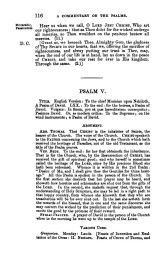
Neale's "Argument" hears the whole psalm in the voice of the Church. Thomas Aquinas gives it as "That Christ is the inhabiter of Saints, the hearer of the Church," and Bede reads the title — "for her that obtaineth the inheritance" — of the Church, redeemed by His precious Blood. The psalm falls into three parts: the prayer to be heard, the request for a right path, and the rewards of the blessed set against the punishment of the wicked.[8]
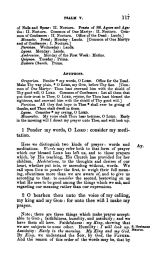
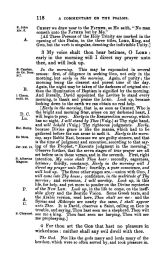
For verse 1's "words" and "meditations," see the article's "Words, meditation, and morning prayer" section, which already quotes Neale's distinction; the exposition around it adds that God is asked to "ponder" words and "consider" meditations, "regarding our meaning rather than our expressions." Verse 2 then names "three things which make prayer acceptable to God; faithfulness, humility, and assiduity": "my King" shows subjection, "I will look up" humility, "Early in the morning" assiduity. "By King, we understand the Son, by God, the Father," and all Three Persons are marked in the opening titles — Lord, King, God — "but the verb is singular, denoting the indivisible Unity."[9]
Verse 3's "early in the morning" is expounded several ways: diligence, purity (the morning being "the clearest and purest time of the day"), the illumination of Baptism, and the Resurrection morning "which has no night." Neale lists seven stages of true prayer here: right intention, eagerness, betimes, constancy, morning direction, pure conscience, and union, confidence, and reverence. And the upward look has its reason: "Look up, because looking down to the earth we can obtain no real help."[10]
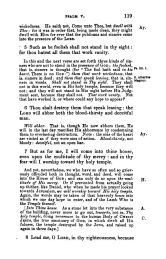
Verses 4–6 set out three kinds of sinners who shall not stand in God's sight: the foolish (thought), those that work wickedness (deed), and those that speak leasing (words) — and God's abhorrence, "though He now abhors them, He will in the last day manifest His abhorrence by condemning them to everlasting destruction." Against them, verse 7's worshipper comes into God's house "only upon the multitude of His mercy," earthly or heavenly, "of the Lamb Who is the Temple thereof." Verse 8's prayer, "Lead me, O Lord, in Thy righteousness," is prayed because the Way is Christ Himself, and Neale notes the verse gives the Office of the Dead its name "Dirige" from the Vulgate.[11]
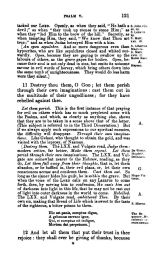
Verses 9–10 expose the enemies' open and secret attacks — the open sepulchre "dangerous and noisome, and as silent in the praises of God, as the tomb" — and verse 11 faces the hardest turn directly:
> Let them perish. This is the first instance of that praying for > evil on others which has so much perplexed some.[12]
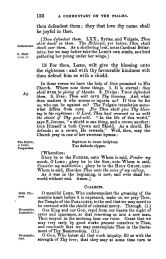
Neale's answer is to take such prayers "in a sense above the letter": applied to spiritual enemies the difficulty disappears. The psalm ends in blessing (vv. 12–13), where Neale notes three things: eternal, divine, and free. And Jerome's distinction closes it: "In the life of this world, a shield is one thing, and a crown another: God Himself is both Crown and Shield. As a shield, He defends; as a crown, He rewards."[13]
Source for this section: J. M. Neale, A Commentary on the Psalms from Primitive and Mediaeval Writers, Vol. I, Psalms I to XXXVIII, second edition (London: Joseph Masters, 1869), Psalm V, pp. 116–123. Neale died in 1866; the text is in the public domain. The quotations above were checked against the scan images (printed pp. 116–122) and not taken from the scan's OCR alone, which garbles words throughout this volume.
See Also
External Links
- The 1928 Psalter, Psalms 1–50, Society of Archbishop Justus
- Augustine's exposition of Psalm 5, New Advent
Source pages
Thumbnails of the source pages for the section above. Click any thumbnail for the full page image. Printed p. 116 is shared with the end of Psalm 4; printed p. 123 is shared with the opening of Psalm 6.
-
 Printed p. 116
-
 Printed p. 117
-
 Printed p. 118
-
 Printed p. 119
-
 Printed p. 120
-
 Printed p. 121
-
 Printed p. 122
-
 Printed p. 123


References
- ↑ The Protestant Episcopal Church in the United States of America, The Book of Common Prayer (1928), The Psalter, First Day, Morning Prayer, Psalm 5, Society of Archbishop Justus transcription.
- ↑ John Mason Neale, A Commentary on the Psalms: From Primitive and Mediæval Writers, vol. 1, 2nd ed. (London: Joseph Masters, 1869), Psalm 5, p. 117, digitized edition at BiblicalStudies.org.uk.
- ↑ The Holy Bible, King James Version, Romans 3:13–14, Bible Gateway.
- ↑ The Holy Bible, King James Version, Matthew 5:44, Bible Gateway.
- ↑ Augustine of Hippo, Exposition on Psalm 5, §17, anonymous translation in Philip Schaff, ed., Nicene and Post-Nicene Fathers, first series, vol. 8 (Buffalo, NY: Christian Literature Publishing Co., 1888), revised by Kevin Knight, New Advent transcription.
- ↑ The Protestant Episcopal Church in the United States of America, The Book of Common Prayer (1928), The Psalter, First Day, and The Order for Daily Morning Prayer, rubric after the Venite, Psalter and Morning Prayer, Society of Archbishop Justus transcriptions.
- ↑ The Protestant Episcopal Church in the United States of America, The Book of Common Prayer (1928), The Order for Daily Morning Prayer, A Collect for Grace, Society of Archbishop Justus transcription.
- ↑ Neale, Psalm V, Argument, p. 116.
- ↑ Neale, Psalm V, pp. 117–118.
- ↑ Neale, Psalm V, p. 118.
- ↑ Neale, Psalm V, pp. 119–120.
- ↑ Neale, Psalm V, > p. 121.
- ↑ Neale, Psalm V, pp. 121–122.